AI Doesn't Remove Complexity. It Moves It.
June 3, 2026
 Ashish Gogula
June 3, 2026
Ashish Gogula
A few months ago, I watched an AI tool generate an entire feature in minutes.
API routes.
Validation.
Database queries.
Frontend components.
Loading states.
Even tests.
Five years ago, that kind of output would have felt impossible.
Now it feels normal.
That is both impressive and deeply misleading.
The conversation around AI in software engineering usually swings between two extremes. Either AI is going to replace every engineer, or AI is just another autocomplete tool that changes nothing.
Neither feels true.
What actually changed is more subtle.
AI is not removing complexity from software engineering.
It is moving complexity somewhere else.
For years, engineering effort was concentrated around writing code.
Syntax mattered.
Framework knowledge mattered.
Boilerplate consumed time.
Entire careers were built around implementation speed.
AI compresses a lot of that instantly.
You can scaffold applications faster than ever. You can generate components, APIs, schemas, tests, documentation, and refactors without touching half the keyboard you used to.
But something interesting happens right after the code is generated.
Ownership begins.
That is where the real engineering work still lives.
The hard part of software was never typing speed.
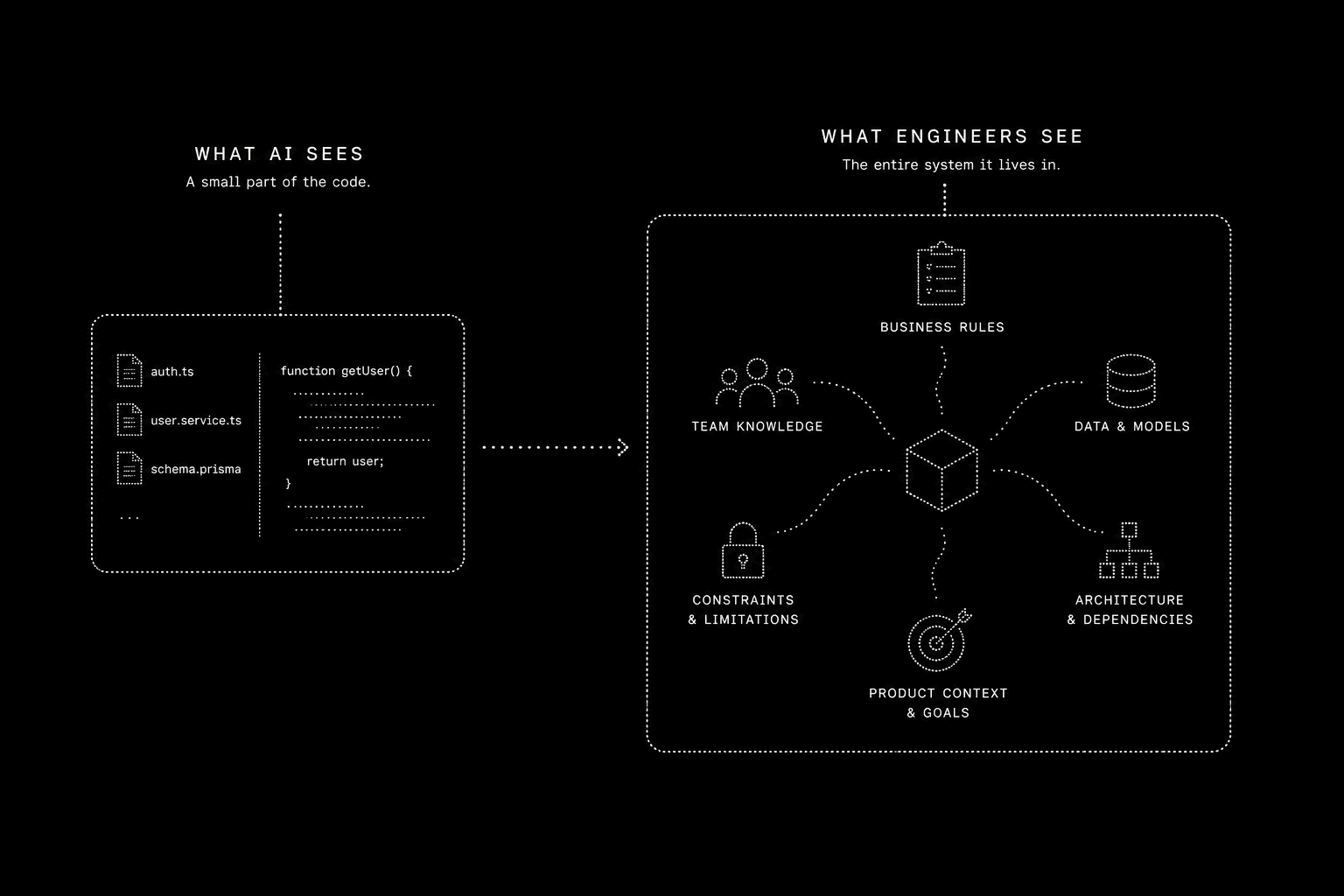
The hard part was understanding why the system exists, what constraints it operates under, how decisions affect each other over time, and what happens six months later when somebody else inherits the codebase.
AI helps produce code.
Humans still absorb consequences.
Generated code often looks correct because locally, it is correct.
The function works.
The API returns data.
The UI renders properly.
The tests pass.
But software systems are not local problems.
They are connected problems.
A small abstraction affects future abstractions. A database decision affects scaling. A shortcut in authentication becomes a production incident months later. Tiny inconsistencies compound across teams until the codebase develops invisible friction.
AI is incredibly good at solving isolated implementation tasks.
Engineering is the process of surviving the long term effects of those tasks.
The more I use AI tools, the more I realize that software engineering is slowly shifting away from implementation and toward decision making.
The value of an engineer is no longer measured by how quickly they can write a component from scratch. Increasingly, the value comes from knowing whether the component should exist at all.
That sounds obvious until you watch large teams adopt AI aggressively.
Something strange starts happening.
Code volume increases dramatically.
Features move faster.
Prototypes appear overnight.
Internal tools multiply.
Repositories expand at uncomfortable speed.
At first, this feels like acceleration.
Then maintenance begins.
The complexity never disappeared.
Ownership simply moved.
People talk about AI quality as if it appears magically.
In reality, the output quality is heavily dependent on the quality of the surrounding system.
Good repository structure improves AI output.
Clear naming improves AI output.
Strong architecture improves AI output.
Predictable patterns improve AI output.
The model is not inventing engineering clarity.
It is amplifying existing clarity.
This is why experienced engineers tend to fear AI less than newer developers.
Senior engineers understand where complexity actually lives.
It rarely lives in syntax.
Most production problems are not caused by somebody forgetting how JavaScript works. They come from unclear ownership, weak architecture, poor boundaries, hidden coupling, scaling mistakes, or product decisions made without long term thinking.
AI does not eliminate these problems.
Sometimes it accelerates them.
Some of the most influential people in technology are already describing the same shift from different angles.
Andrej Karpathy introduced the idea of Software 3.0, where programming moves beyond traditional code and becomes increasingly driven by intent expressed through language.
Satya Nadella revealed that a significant percentage of Microsoft's internal code is already AI-generated.
Mark Zuckerberg openly stated that he expects AI to eventually handle a large portion of software development work.
Dario Amodei described a future where humans move upward into oversight, architecture, and higher-level direction while AI handles more implementation work underneath.
Four of the most influential people in technology are effectively pointing toward the same reality.
Code generation is becoming abundant.
Judgment is becoming scarce.
And historically, scarce things become valuable.
The scariest thing about AI generated code is not that the code is bad.
Sometimes the code is surprisingly good.
The scary part is how easy it becomes to approve code nobody fully understands.
When code generation becomes cheap, code review becomes the bottleneck.
And humans are much better at reviewing working code than maintainable code.
That difference is creating a new kind of technical debt.
Not messy code.
Invisible code.
Code that technically works but lacks intentionality.
Code that nobody deeply understands because nobody fully wrote it.
Code that slowly turns systems into black boxes.

I think this is where the industry becomes uncomfortable.
For years, technical debt was visible.
Messy files.
Bad naming.
Duplicated logic.
Legacy systems.
AI generated debt feels different.
The code often looks clean.
Sometimes cleaner than human written code.
But cleanliness is not the same thing as coherence.
A codebase can look polished while becoming increasingly fragile underneath.
The danger is not that AI writes terrible software.
The danger is that it allows teams to scale complexity faster than they scale understanding.
This is why architecture suddenly matters more again.
For a while, frontend engineering especially became obsessed with tooling velocity. New frameworks appeared constantly. Abstractions stacked on abstractions. Entire ecosystems optimized around reducing friction during implementation.
AI pushes that trend even further.
But once implementation becomes commoditized, higher level thinking becomes more valuable.
System design matters more.
Product thinking matters more.
Taste matters more.
Restraint matters more.
Ironically, AI may push engineering back toward fundamentals.
Not away from them.
The engineers who benefit most from AI are usually not the ones blindly generating the most code. They are the ones capable of directing systems clearly, spotting weak abstractions early, understanding tradeoffs, and maintaining coherence as complexity grows.
In other words, the people who understand software beyond syntax.
I do not think engineering is disappearing.
I think engineering is changing layers.
We are moving from builders of code into editors of systems.
Less typing. More judgment.
Less boilerplate. More architecture.
Less memorization. More clarity.
The future engineer may write fewer lines of code than ever before while carrying more responsibility than ever before.

AI is not replacing engineers.
It is exposing what engineering actually was all along.
Software engineering was never about typing speed.
It was about understanding systems deeply enough to make good decisions under uncertainty.
AI changes how we build.
It does not remove the need to think.
And honestly, I think that realization makes software engineering more interesting, not less.
The most interesting part of this entire shift is that software is starting to feel different again.
The interface between humans and computers is changing.
The way we build products is changing.
The speed of implementation is changing.
But something else is quietly becoming more important at the same time.
Clarity.
Not just in code.
In thinking.
The engineers who stand out over the next decade probably will not be the ones who generate the most code.
They will be the ones who understand systems deeply enough to guide complexity without drowning in it.
AI accelerates output.
But engineering was never just output.
It was judgment.
And I think the industry is slowly rediscovering that.
AI made code easier to generate.
It did not make software easier to understand.
And that difference may define the next decade of engineering.