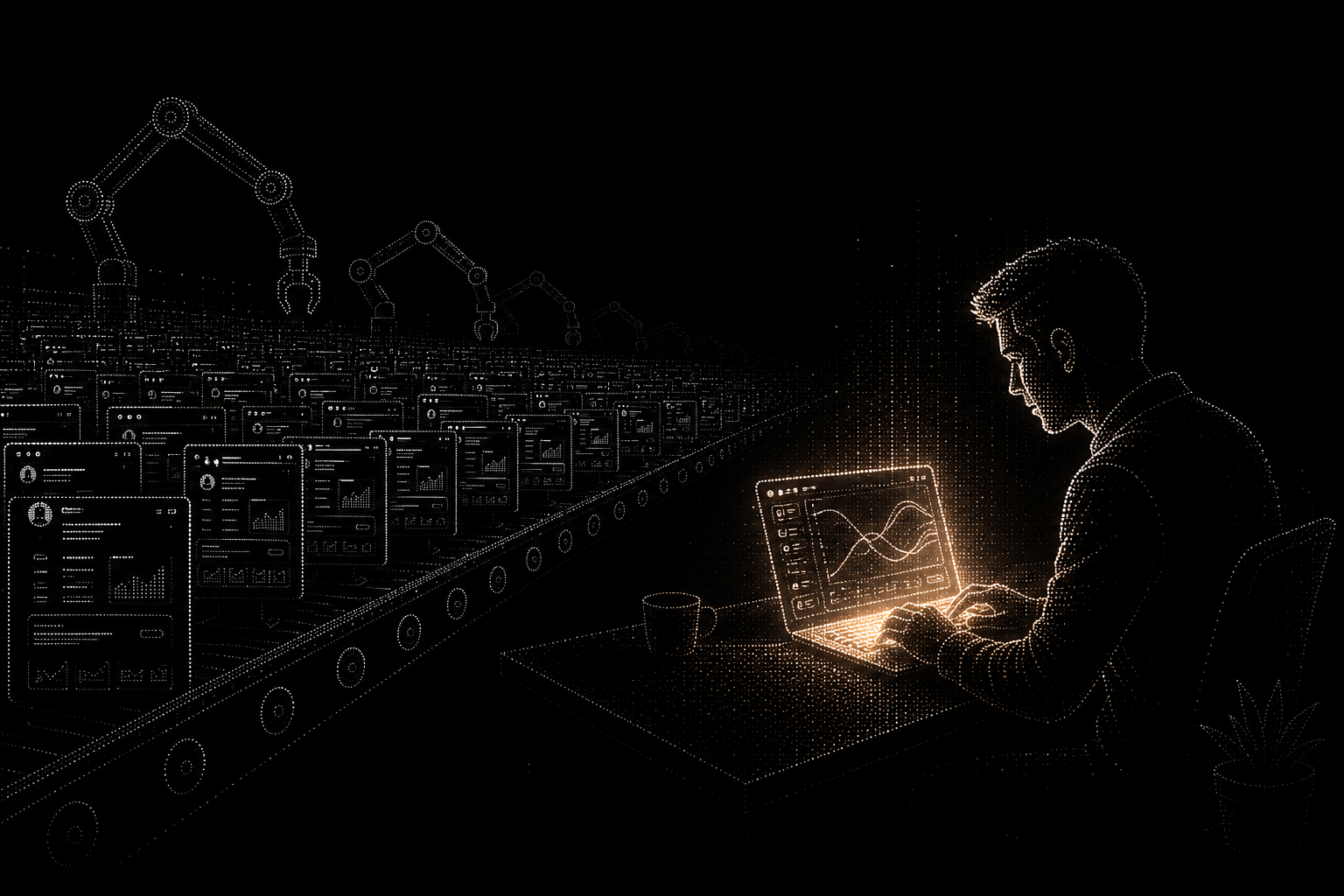
The Cost of Cheap Code
June 13, 2026
 Ashish Gogula
June 13, 2026
Ashish Gogula
A few days ago, Apple dropped its design principles at WWDC26.
Eight core pillars.
Purpose. Agency. Responsibility. Familiarity. Flexibility. Simplicity. Craft. Delight.
On the surface, they read like standard platform guidelines. Polished. Human-centric.
But reading them today feels different.
Five years ago, these principles were constraints we fought against while struggling through the mud of implementation. We spent eighty percent of our sprint cycles handling cross-browser rendering quirks or debugging layout shifts on low-end devices.
Now, UI infrastructure is a solved problem. Large language models can scaffold a highly responsive, structurally sound layout in seconds.
The baseline barrier to entry has dropped to zero.
Which means the delta between a functional interface and an exceptional product has never been wider.
We are entering an era where layout execution is a commodity, and interactive craft is the only remaining scarcity.
As engineering organizations, we have historically treated velocity as our ultimate proxy metric.
How fast can we ship the feature?
How quickly can we spin up the next view?
Because automated tools have optimized the baseline of building, our development cycles are accelerating. Components render flawlessly out of the box. Tailwind grids align instantly. TypeScript interfaces catch type mismatches before runtime.
But there is a structural chasm between an interface that works and an interface that feels alive.
When execution becomes frictionless, teams easily mistake delivery speed for user value.
You generate a gorgeous layout. It has the correct padding, mathematically proportional typography, and a modern color token system. It passes CI/CD checks seamlessly.
But when you scroll, the viewport feels static.
When you trigger a modal, the layout transition snaps abruptly, disorienting the user's spatial awareness.
When a 300ms network latency spike hits, a skeleton state flashes violently, shattering the illusion of a tactile application.
The tooling solved the layout equation.
It failed to solve the sensory experience.
At WWDC, Apple defined Craft as meticulous attention to detail—using premium materials, fluid animations, and robust performance to inspire confidence.
In client-side engineering, our "materials" aren't glass or aluminum.
Our materials are time, motion, and hardware threads.
True craft rarely registers in a static design file or a pull request diff. It lives entirely in the interstitial spaces—the micro-windows of time between a user’s physical intent and the application’s response.
It is the subtle cubic-bezier deceleration curve on a draggable sheet that mimics physical mass.
It is the way a button slightly stretches on press before snapping into its active state, providing haptic reassurance.
It is the invisible DOM optimization and paint-bound styling that keeps a complex interactive canvas locked at a steady 120 frames per second.
LLMs are incredible at local execution. They know what a standardized UI element looks like. They can generate the syntax for a motion hook perfectly.
But they do not have a nervous system.
They cannot feel whether a spring physics configuration has too much tension, or if a micro-interaction feels heavy under a user's thumb over repeated daily workflows.
That calibration requires systemic taste. And taste cannot be automated.
When everything is cheap to build, the default organizational reflex is to build everything.
More interactive flourishes.
More complex page transitions.
More data density.
This is where the principle of Simplicity cuts through the noise. Simplicity isn't just about stripping down a layout until it's empty; it’s about making the core system architecture shine without cognitive load.
When the volume of generated code increases exponentially, technical noise increases with it.
The value of an engineer is shifting away from code generation and toward intentional architectural restraint.
Knowing exactly which layout transition not to build.
Knowing when a micro-interaction is distracting rather than guiding.
Knowing when to let an interface remain completely still.
Every extra piece of motion or high-fidelity animation demands a tiny fraction of the user's cognitive processing power. If it doesn't serve a structural purpose—if it doesn’t orient their focus or provide immediate state feedback—it is just digital bloat.
We are moving away from an era where we spend hours writing boilerplate to make layouts functional.
We are moving into an era of system calibration.
The role of the frontend architect is shifting. We are spending less time fighting syntax and more time orchestrating weight, latency, and spatial logic. We are refactoring components to ensure they feel tactile, predictable, and forgiving.
If code is cheap, anyone can ship a functional application.
But the products that define the next decade won't win because they have the most features or the fastest development cycles.
They will win because they respect the human on the other side of the viewport.
They will win because an engineer cared enough to fine-tune the curves, optimize the frame-rates, and inject intentionality into the codebase.
Automation can give you the baseline.
But craft is still an engineering discipline.
Reference :
WWDC26: Principles of great design | Apple (opens in new tab)